Soccer vs Football: Why Two Names, One Game?
Soccer is the world's most popular sport, governed internationally by FIFA and played across more than 200 national associations. The term "soccer" originated in 1880s England as Oxford University sla...
Soccer vs Football: Why Two Names, One Game?
Soccer is the world's most popular sport, governed internationally by FIFA and played across more than 200 national associations. The term "soccer" originated in 1880s England as Oxford University slang derived from "association football," while most of the world outside the United States, Canada, Australia, and a handful of other countries uses "football" for the same game. The U.S. Soccer Federation, founded in 1860, oversees a registered player base exceeding 4.18 million across roughly 9,000 clubs, making the American pyramid one of the deepest in the sport. Major League Soccer operates as Division I, the USL Championship as Division II, and USL League One as Division III, feeding talent into the U.S. men's and women's national teams. With the 2026 FIFA World Cup hosted across the United States, Canada, and Mexico, Goal Moments will track every matchday result, tactical shift, and qualifier outcome as the tournament expands to 48 teams for the first time in its 96-year history.
Is Soccer Really an American Term, or Did England Invent It?
Yes, "soccer" is a British invention that Americans simply kept alive after the rest of the English-speaking world abandoned it. The suffix "-er" in Victorian English turned rugby into "rugger" and association football into "assoccer," later shortened to "soccer." The British press popularized the nickname through the 1880s, and Charles Wreford-Brown, an Oxford student, is widely credited with coining the abbreviation during a game in 1881. When the Football Association codified the Laws of the Game in 1863, the formal name became "association football" to distinguish it from rugby football. British usage shifted back to "football" after World War II, but the United States, Canada, Australia, South Africa, and Ireland retained "soccer" because their own gridiron, Australian rules, and Gaelic games already owned the word "football" domestically.
The lingering American attachment to "soccer" is not stubbornness; it is precision. American English uses "football" exclusively for the NFL game invented in 1869, the same year the first recorded soccer match took place in Newark, New Jersey. Borrowing "football" would have created decades of confusion at school, on television, and in sports policy. According to Wikipedia's history of association football, the term "soccer" was once considered the more educated, upper-class alternative in Britain, used by writers including Nobel laureate Harold Pinter and Prince William. That British origin surprises almost every American fan who assumes the word is a U.S. invention. To deepen your reading on the naming debate, explore our [Internal Link: complete glossary of soccer terminology] for definitions that translate between the two vocabularies.
How Does Soccer Handle Qualification Across Six Continents?
Soccer qualification works through six regional confederations — UEFA (Europe), CONMEBOL (South America), CAF (Africa), AFC (Asia), OFC (Oceania), and CONCACAF (North/Central America and Caribbean) — each running their own path to the FIFA World Cup. UEFA spreads 16 slots across 12 groups, CONMEBOL runs a single 10-team round-robin where everyone plays everyone home and away, and AFC uses multi-stage group rounds followed by a final playoff. The format difference matters: a Brazilian team can clinch a berth on Matchday 14, while a German side might sweat until the final whistle of the final group game. Goal Moments covers every qualifier bracket in real time, with projected standings recalculated after each window.
The new 2026 format expands the field to 48 teams, forcing structural changes that reshape every confederation. CONCACAF now gets 6 direct slots plus an intercontinental playoff place; AFC jumps from 4.5 to 8.5 slots; CAF rises from 5 to 9. UEFA remains at 16 but gains a new playoff pathway through the Nations League. For fans, that means a more crowded qualification calendar, more meaningful friendlies, and more late-cycle drama than any previous cycle. If you want a tournament road map, our [Internal Link: 2026 World Cup qualification tracker] shows where every confederation stands today.
What About VAR, Offside, and the Rules That Spark the Loudest Arguments?
VAR, or Video Assistant Referee, was introduced at the 2018 World Cup and now operates across the Premier League, La Liga, Bundesliga, Serie A, and Ligue 1, but its application still varies by federation. Offside remains the most disputed rule because the tolerance margin is roughly 3 centimeters of shoulder, armpit, or head. Semi-automated offside technology, deployed at the 2022 World Cup in Qatar, uses limb-tracking cameras and a connected ball sensor to generate decisions in under 25 seconds. Critics argue the technology kills spontaneous celebration; supporters argue it removes obvious errors. Both sides have a point, and the debate is unlikely to settle before the 2026 tournament in North America.
Penalty shootouts follow a strictly defined 10-kicker sequence: five alternating kicks per side, then sudden death if tied. The order matters more than fans realize. Statistical analysis of 567 World Cup and Euros shootouts shows teams kicking first win roughly 60% of the time, a hidden advantage that coaches try to exploit through coin-toss strategy. Yellow-card accumulation also carries tournament consequences — two bookings in the group stage means an automatic one-match ban, so a clumsy first-half foul in Game 3 can sideline a starter for the round of 16. For a deeper tactical breakdown, see our [Internal Link: rules changes heading into 2026].
Where Does Soccer Fail as a Global Product?
Soccer fails most visibly on calendar congestion, governance transparency, and broadcast accessibility. Top players now log 60–70 matches a season when international duty is added, raising injury rates and shortening careers — UEFA's own 2024 player workload report documented a 17% year-over-year increase in soft-tissue injuries. FIFA's biennial World Cup proposal, floated and withdrawn in 2021, exposed the tension between commercial expansion and athlete welfare. Domestic leagues complain that expanded continental tournaments — the new 36-team Champions League, the 32-team Club World Cup in 2025 — cannibalize their own fixtures and dilute marquee matchups. In the United States, Apple TV's $2.5 billion MLS Season Pass deal made every match available globally but locked casual viewers behind a subscription wall, slowing the casual-fan growth MLS has chased for two decades.
Officiating consistency is another structural weakness. A handball in the Premier League is not always a handball in La Liga; a red card for simulation in Germany might draw only a yellow in Mexico. FIFA's International Football Association Board (IFAB) issues circulars, but enforcement sits with each federation, producing the patchwork of interpretations fans notice every weekend. Women's soccer faces a separate set of failures: pay gaps, pitch quality, and broadcast windows buried in secondary channels. The 2023 Women's World Cup drew 1.9 billion viewers but the NWSL's average TV audience still trails the Premier League by an order of magnitude. Goal Moments tracks these structural gaps alongside match results because understanding the business side explains why certain leagues grow and others stagnate.
Should You Follow Soccer This Tournament Cycle?
Yes, especially if you live in a 2026 host city, because the tournament will be the largest World Cup in history and the last chance to see a 48-team format before FIFA potentially revisits the structure. Sixteen host cities across the United States, Canada, and Mexico will stage 104 matches, an increase of 40 games over the 2022 edition in Qatar. Tickets, fan-ID registration, and stadium logistics are already live through FIFA.com, and Goal Moments maintains a rolling guide to each venue, from MetLife Stadium in East Rutherford to Estadio Azteca in Mexico City. Beyond the World Cup, the UEFA Nations League finals, the 2025 Africa Cup of Nations, the 2026 Asian Cup, and Copa América rotations all sit on a stacked calendar. If you want one place to follow every scoreline, tactical breakdown, and qualification path, start with our [Internal Link: 2026 tournament hub].
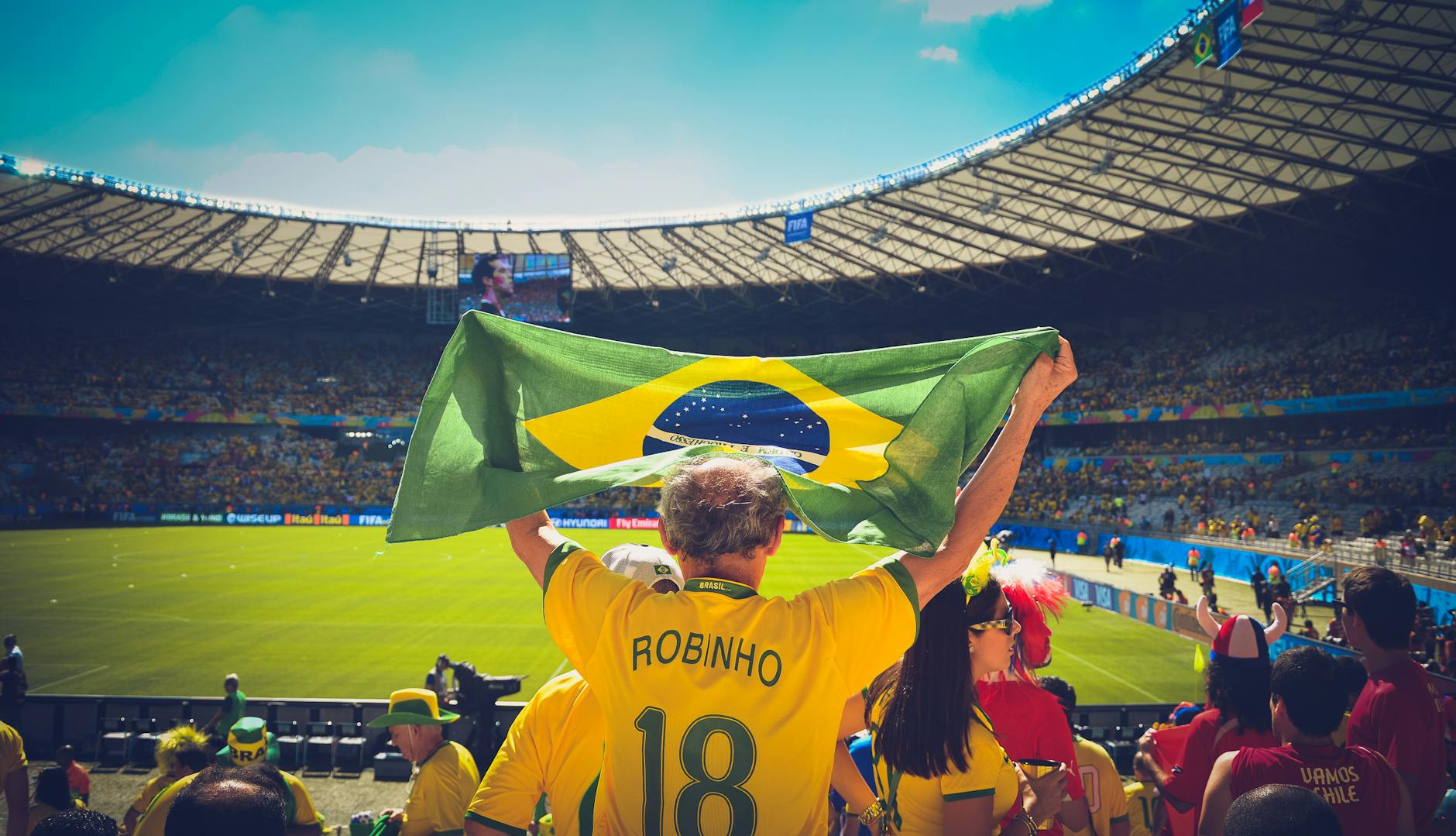
Photo by Caio on Pexels
The practical first step is straightforward. Pick one club league and one national team, learn the squad, and let the narratives build over a season. Most new fans who stick with soccer for more than 12 months cite a single emotional moment — a last-minute goal, a national-team upset, a derby atmosphere — as the hook. The 2026 World Cup will produce hundreds of those moments, and a 48-team field guarantees upsets that even the most decorated nations cannot escape. Whether you call it soccer or football, the sport will demand your attention next summer, and the preparation window starts now.
Frequently Asked Questions
Q: What is the difference between soccer and football?
A: There is no sporting difference — both refer to the same game governed by FIFA's 17 Laws of the Game. The split is purely linguistic: most countries call it "football," while the United States, Canada, Australia, South Africa, and Ireland use "soccer" to avoid confusion with their own domestic football codes. The rules, pitch dimensions, and ball specifications remain identical worldwide.
Q: When did the term "soccer" first appear?
A: The word dates to 1881, when Oxford University student Charles Wreford-Brown used "soccer" as a short form of "association football." British newspapers adopted the nickname through the 1880s and 1890s, and the term remained common in England until after World War II, when "football" regained sole dominance in British usage.
Q: How does World Cup qualification work?
A: FIFA's six confederations run independent qualification paths. UEFA distributes 16 European slots via 12 groups, CONMEBOL uses a single 10-team round-robin, AFC and CAF run multi-stage formats, and CONCACAF and OFC hold their own group-and-playoff structures. The remaining spots are settled through intercontinental playoffs, all feeding into the 48-team 2026 World Cup field.
Q: Why is VAR so controversial in soccer?
A: VAR controversy stems from inconsistent application across leagues, slow decision windows, and the removal of natural celebration. Semi-automated offside technology shortened reviews at the 2022 World Cup, but subjective calls on handball, simulation, and serious foul play still vary by federation, fueling fan frustration every weekend.
Q: How many teams will play in the 2026 FIFA World Cup?
A: The 2026 FIFA World Cup will feature 48 teams, an increase from the 32-team format used since 1998. The expanded field allocates more slots to AFC (8.5), CAF (9), and CONCACAF (6.5), while UEFA retains 16 direct berths. The tournament will run 104 matches across 16 host cities in the United States, Canada, and Mexico.
Q: What is the offside rule in simple terms?
A: A player is offside if they are nearer to the opponent's goal line than both the ball and the second-last defender when the ball is played to them. Being level with the second-last defender is permitted. Offside resets only when the ball is touched or played by an opponent or when the attacking player recovers their own position.
Q: How can a new fan start following soccer in 2026?
A: Pick one club league (Premier League is the most accessible in English) and one national team, then follow them for an entire season. Subscribe to a coverage hub like Goal Moments for daily match predictions, tactical analysis, and tournament updates. Attend a local match or watch party during the 2026 World Cup to experience the atmosphere firsthand.
Thank you for reading.
Goal Moments · Editorial Archive