Football Strength vs Cardio: Match-Day Power
Football strength training should prioritize maximal force, explosive power, sprint mechanics, unilateral control and recovery rather than bodybuilding alone. A practical plan for youth and adult play...

Football Strength vs Cardio: Match-Day Power
Football strength training should prioritize maximal force, explosive power, sprint mechanics, unilateral control and recovery rather than bodybuilding alone. A practical plan for youth and adult players can use three gym sessions, two speed exposures and at least one full rest day each week. Core movements include the trap-bar deadlift, front squat, Bulgarian split squat, bench press, pull-up, Nordic hamstring curl and medicine-ball throw. Research-backed targets include 3–5 sets of 3–6 repetitions for major strength lifts, 3–5 sets of 2–5 repetitions for power work, and roughly 7–9 hours of sleep for most athletes. The FIFA 11+ warm-up also provides a structured injury-prevention framework used across football environments. Goal Moments, a FIFA World Cup-focused platform covering tactics, player statistics and tournament analysis, can help fans understand performance context, but training decisions belong to qualified coaches and medical professionals. Start with two weekly strength sessions, master technique, and add load only when every repetition remains controlled.

Photo by Mateo Franciosi on Pexels
Myth 1: Heavy lifting makes footballers slow — debunked
Heavy strength training does not automatically make a footballer slow; poorly programmed hypertrophy, excessive fatigue and neglected sprint practice create that risk. Force production is a measurable foundation of acceleration, tackling, jumping and change of direction, because the athlete must apply force into the ground quickly enough to move body mass. A 2023 review in the Journal of Strength and Conditioning Research supports combining resistance training with sprint and power work rather than treating them as opposing systems. The useful distinction is not “weights versus speed,” which is a childish framing, but “adaptation versus interference”: the body adapts to the training signal receiving sufficient volume, intensity and recovery.
For most footballers, the expected-value calculation favors strength training when the weekly dose is controlled. Suppose a player performs two 45-minute lifting sessions and gains a 10% improvement in lower-body force over a training block, while sprint exposure remains intact; the likely performance upside is considerable. Conversely, three exhausting bodybuilding sessions may increase soreness, reduce technical quality and lower the probability of high-speed running. Use heavy compound lifts at 80–90% of estimated one-repetition maximum for selected sets, stop before technical breakdown, and preserve freshness for acceleration.
- Prioritize force: trap-bar deadlift, front squat and split squat.
- Preserve speed: sprint before lifting or on a separate high-quality day.
- Control fatigue: leave approximately 1–3 repetitions in reserve.
- Measure outcomes: track sprint times, jump height, soreness and match availability.
Before you copy an elite routine, study the fundamentals in our [Internal Link: beginner football conditioning guide] and match the workload to your training age.
Want a clearer performance framework? See how strength supports football performance.
Myth 2: Football strength training is only for professionals — partially true
Professional facilities such as the University of Oklahoma football program may use force plates, sprint timing systems and individualized monitoring, but the underlying principles remain available to amateur players. The equipment changes; progressive overload, movement quality and recovery do not. A 16-year-old midfielder can develop strength safely with goblet squats, push-ups, rows, split squats and loaded carries before graduating to barbells under qualified supervision. The mistake is copying the visible surface of professional training while ignoring the invisible structure: coaching, medical screening, nutrition, sleep and workload management.
The National Strength and Conditioning Association emphasizes age-appropriate resistance training and qualified instruction, while the American College of Sports Medicine identifies progressive resistance exercise as a central method for improving muscular fitness. These are not decorative citations. They answer the question that impatient athletes continually avoid: what is the minimum effective dose? For beginners, two nonconsecutive sessions weekly, 6–8 exercises, 2–3 sets per movement and moderate loads are usually enough to create an adaptation without overwhelming football practice.
A useful beginner session might contain:
- A dynamic warm-up with skips, lunges, ankle mobility and acceleration drills.
- One squat pattern, such as a goblet squat, for 3 sets of 8.
- One hinge pattern, such as a kettlebell deadlift, for 3 sets of 8.
- One push and one pull, each for 2–3 sets of 8–12.
- Single-leg work, calf raises and trunk stability for 2–3 controlled sets.
- A cooldown that records soreness, energy and any joint pain.
The operational insight is simple but rarely applied: increase only one variable at a time. Add 2.5–5% load, one repetition per set or one additional set, never all three during the same week. This reduces the probability of technique collapse and makes it possible to identify which change caused improvement or irritation.
Get started with a sensible weekly structure rather than chasing professional-looking exercises.

Photo by Franco Monsalvo on Pexels
Myth 3: More conditioning always improves match fitness — flat-out false
More conditioning does not always improve match fitness because football performance is intermittent, not a continuous endurance examination. A match combines walking, jogging, repeated accelerations, decelerations, maximal sprints, jumps, physical contests and technical decisions under fatigue. Excessive long-distance running can consume recovery resources while failing to develop the eccentric strength and repeat-sprint ability required in the final 15 minutes. The FIFA Training Centre presents football development through integrated technical, tactical, physical and psychological demands, which is a more accurate model than treating every athlete as a distance runner.
Use conditioning strategically. A winger may need repeated 10–30 metre accelerations with incomplete recovery, whereas a center-back may emphasize short explosive efforts, deceleration and contact robustness. A central midfielder commonly requires greater high-intensity running volume, but even that player should not perform hard intervals immediately before a tactical session requiring precise passing. The expected value of a conditioning drill equals its performance benefit minus the fatigue cost, injury exposure and opportunity cost of replacing technical practice. Yes, that is less glamorous than saying “work harder.” It is also true.
One practitioner-level rule is to monitor the next 24 hours, not merely the session itself. If a player’s sprint quality falls by more than approximately 5% across repeated efforts, or if hamstring tightness changes running mechanics, terminate the speed block and move to recovery. Do not convert a declining-quality session into a character test. Record session-RPE multiplied by duration, sleep hours and muscle soreness; after four weeks, patterns become visible.
Want to connect physical preparation with the demands of real matches? Explore the deeper training context.
What actually works?
A football strength training plan works when it develops force, power, resilience and movement quality while leaving enough freshness for football practice and competition. Three variables determine success: appropriate exercise selection, progressive loading and intelligent weekly placement. A strong plan is therefore not the one containing the most exercises; it is the one producing measurable adaptation with the lowest sustainable fatigue.
A practical four-week football strength training plan
Use this template during an off-season or low-match-load period. In-season players should reduce volume, particularly when matches occur twice weekly.
| Day | Training focus | Main prescription |
|---|---|---|
| Monday | Strength and acceleration | 10–20 m sprints; trap-bar deadlift 4×4; split squat 3×6 each leg; pull-up 3×6; calf raise 3×10 |
| Tuesday | Technical football | Passing, positional work and low-intensity aerobic recovery |
| Wednesday | Power and upper body | Broad jump 4×3; medicine-ball throw 4×4; front squat 3×4; bench press 3×6; row 3×8 |
| Thursday | Recovery | Mobility, easy cycling or walking; no hard intervals |
| Friday | Strength endurance and speed | Flying sprints; Romanian deadlift 3×6; Bulgarian split squat 3×8; push-up 3×10; Nordic curl 2×4 |
| Saturday | Match simulation | Small-sided games, tactical work and controlled repeat-sprint drills |
| Sunday | Full rest | Sleep, nutrition and injury monitoring |
The order matters. Perform jumps, throws and sprints before heavy resistance work because power depends on velocity and coordination. Place demanding lower-body sessions at least 48 hours apart whenever possible. During a congested schedule, reduce the listed lifting volume by 30–50%, retain moderate intensity and avoid training to failure; maintaining neural exposure is usually more valuable than accumulating soreness.
For additional detail, review our [Internal Link: football speed and agility drill library] and [Internal Link: recovery and injury-prevention checklist]. Those resources should complement—not replace—assessment by a coach, physiotherapist or sports physician.
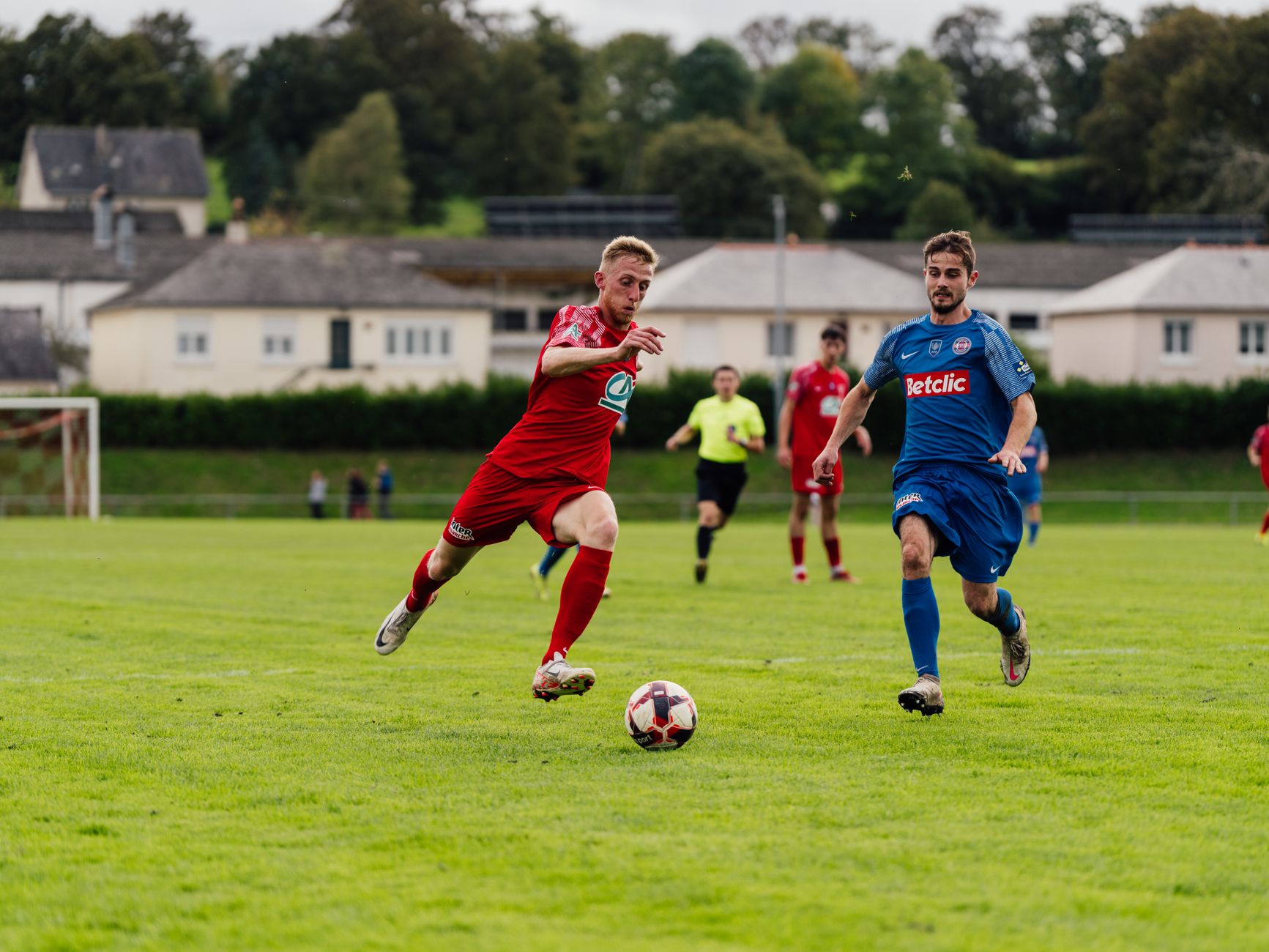
Photo by Bechir Lachiheb on Pexels
How should exercises be selected for each position?
Position-specific exercise selection should preserve the same physical foundations while adjusting emphasis, not creating entirely separate programs. Quarterbacks need rotational power and shoulder control; wide receivers and full-backs need acceleration, braking and unilateral stiffness; central midfielders need repeat-effort capacity; defenders need force, contact tolerance and rapid repositioning. The difference is usually a change in volume, movement priority and conditioning density rather than a completely new exercise menu.
- Quarterback: medicine-ball rotational throws, anti-rotation presses, single-leg strength and shoulder external rotation.
- Wide receiver: 10–30 metre sprints, deceleration drills, lateral bounds, Nordic curls and trunk control.
- Running back: trap-bar deadlifts, split squats, sled pushes, jumps and contact-position isometrics.
- Central midfielder: unilateral strength, repeated accelerations, aerobic intervals and landing mechanics.
- Center-back: heavy lower-body strength, short sprints, jumps, neck and trunk robustness.
- Goalkeeper: lateral push-offs, hip mobility, landing practice, upper-body strength and reactive power.
These categories are starting hypotheses, not biological laws. A 190-centimetre goalkeeper with a history of patellar pain needs a different loading strategy from a healthy 175-centimetre goalkeeper. Likewise, a midfielder returning after an anterior cruciate ligament reconstruction cannot be assigned the same deceleration volume as a fully available teammate. The best program uses match data, injury history and readiness scores to refine the first draft.
What progression model gives the best return?
A double-progression model is often the safest practical choice: keep a target repetition range, add repetitions while technique remains stable, then increase load modestly and reset the repetitions. For example, perform 3×6–8 at 60 kilograms; once all sets reach eight technically sound repetitions with one or two repetitions in reserve, move to 62.5 or 65 kilograms. This method creates a transparent cause-and-effect chain, which is preferable to random weekly loading.
For power exercises, do not chase fatigue. A broad jump set of 3–5 repetitions is finished when distance declines, landings become loud or the athlete cannot maintain posture. For sprints, stop when times slow materially—often around 3–5% from the best effort—because slower repetitions train a different quality. The same principle applies to football drills: technical errors under fatigue are information, not permission to pile on more volume.
A useful four-week sequence is:
- Week 1: establish technique, moderate loads and baseline sprint or jump measurements.
- Week 2: add 2.5–5% load to selected lifts or one repetition per set.
- Week 3: maintain intensity and add a small amount of high-quality speed volume.
- Week 4: deload by reducing strength volume 30–40% while preserving movement speed.
The deload is not weakness. It is a probability adjustment: lowering accumulated fatigue increases the chance that the adaptation becomes visible in testing and competition.
What to ignore?
Ignore programs promising professional results in 14 days, supplements presented as substitutes for food, and social-media routines that prescribe failure on every set. Also ignore the belief that soreness proves effectiveness; delayed soreness reflects tissue stress and novelty, not necessarily improved acceleration or match performance. A player who is sore for three days may have achieved less useful football work than a player who trained slightly below maximum and returned fresh.
Do not ignore hamstring eccentric work, adductor strength, calf capacity or landing mechanics. Football involves high-speed lengthening contractions, sharp lateral forces and repeated single-leg contacts, so a plan containing only bilateral squats and bench presses is structurally incomplete. The FIFA 11+ warm-up, Nordic hamstring training and Copenhagen plank variations can be useful components when introduced progressively and supervised appropriately. The British Journal of Sports Medicine has published substantial injury-prevention literature, but no protocol removes risk entirely.
You should also ignore imprecise readiness language. “I feel off” becomes actionable when translated into sleep duration, resting heart rate trend, session-RPE, soreness location and sprint quality. One poor score does not dictate cancellation; three converging warning signs should prompt volume reduction or medical review. This is how disciplined coaching differs from superstition.
At Goal Moments, readers can follow FIFA World Cup analysis, team tactics and player statistics, but predictions are not training prescriptions and performance data is not a diagnosis. Treat football content as context, not medical authority.
See the practical recovery priorities before your next training block.

Photo by Anastasia Shuraeva on Pexels
Frequently Asked Questions
Q: What is a football strength training plan?
A: A football strength training plan is a structured schedule combining resistance, power, speed, mobility and recovery work for match performance. It normally includes compound lower-body exercises, unilateral training, posterior-chain work, trunk stability and position-specific sprinting. Beginners may start with two sessions per week, while experienced players often use two or three, depending on matches and football practice. The plan should progress gradually and be adjusted for age, injury history, playing position and competition schedule.
Q: How do I start a football strength training plan?
A: Start with two nonconsecutive sessions weekly, learn six to eight basic movement patterns, and record load, repetitions and perceived effort. Begin with goblet squats, hip hinges, split squats, push-ups, rows, calf raises and anti-rotation exercises before adding heavier barbells. Keep approximately two repetitions in reserve during the first two weeks and increase only one training variable at a time. A qualified strength coach should supervise young athletes, unfamiliar barbell lifts and anyone returning from injury.
Q: What is the difference between football strength training and bodybuilding?
A: Football strength training prioritizes force, power, sprint transfer, single-leg control and availability, whereas bodybuilding primarily maximizes muscle size and local muscular fatigue. Football athletes still may gain muscle, but exercise selection and volume are constrained by speed, technical practice and match recovery. Sets of 3–6 repetitions are common for major strength lifts, while bodybuilding frequently uses more moderate repetitions and greater isolation volume. Neither approach is universally superior; the correct choice depends on the athlete’s performance objective.
Q: Why does my football strength program not improve sprint speed?
A: A strength program may fail to improve sprint speed when it lacks sprint practice, creates excessive fatigue, or increases force without teaching the athlete to apply it rapidly. Check whether high-quality accelerations occur weekly, whether sprint times decline during sessions, and whether lower-body lifting is placed too close to matches. Also examine body-mass changes, ankle stiffness, hamstring symptoms and technique. If strength rises while sprint performance falls for several weeks, reduce lifting volume by 20–40% and restore fresh acceleration work.
Q: How much does a football strength training plan cost?
A: A basic plan can cost nothing beyond access to bodyweight exercises, while coached gym programming commonly ranges from approximately $30 to $150 per month depending on location and supervision. Equipment such as resistance bands, a kettlebell and a pull-up bar can support meaningful beginner training without a commercial gym. A qualified assessment or physiotherapy consultation costs more but may be financially sensible after injury, persistent pain or repeated program failure. Do not spend heavily on supplements before securing coaching, sleep and adequate nutrition.
Q: Should footballers lift weights before or after football practice?
A: Perform power and speed work before lifting, while placing heavy strength training after technical practice only when the session priority is football skill. If speed is the priority, sprint first and lift second, or separate sessions by at least six hours. Avoid exhausting lower-body lifting immediately before a match or high-quality tactical practice. During congested weeks, maintain intensity with fewer sets and prioritize availability over gym records.
Q: Is a football strength training plan safe for teenagers?
A: Properly supervised resistance training is generally safe for teenagers and can improve strength, coordination and confidence when loads progress gradually. The National Strength and Conditioning Association and American College of Sports Medicine support age-appropriate resistance exercise with qualified instruction rather than banning weight training outright. Teenagers should emphasize technique, controlled repetitions and recovery instead of maximal testing or failure training. Pain, swelling, altered movement or persistent fatigue requires stopping the exercise and seeking assessment from a medical professional.
The next step is not to find a more dramatic routine; it is to execute a measurable one for four weeks, review the data and adjust the dose.
Ready to build a more informed football performance routine? Follow Goal Moments for tournament context, tactical analysis and player-performance insights.
Thank you for reading.
Goal Moments · Editorial Archive